

By Fransisco Msonge (MD), 2026.
Content
- 1.Origin of 666 number
- 2.The Number of the Beast
- 3.Vicarius Filii Dei in Historical Context
- 4.The Title Pontifex Maximus
- 5.Nine Distinct Features of the Anti-Christ
- 6.Bibliography
1.THE ORIGIN OF THE NUMBER 666
One aspect of Baal worship that continues to ensnare millions today is divination. Very few people understand what the term truly means, and even fewer realize that the practice of it is an abomination before the Lord.
Deuteronomy 18:10–12 shows that divination is not from God; it is an abomination to Him. This is one of the many reasons the Lord told Joshua to destroy the Canaanites, including both women and children, in Deuteronomy 7:1–26.
What is divination?
Divination is the practice of seeking knowledge of the future or hidden things through supernatural methods such as omens, spirits, magic, or fortune-telling. Examples often described as divination include fortune-telling, consulting spirits or mediums, interpreting omens or signs, astrology (seeking guidance from the stars), and using charms, objects, or rituals to predict events.
Divination was, and still is, believed by many to be sent from God. To the pagans, the person who could perform this system of divination was not only considered wise and holy but was also believed to have the spirits of the living gods in him. Many people would not even venture out of their houses unless they first consulted a diviner.
By using mathematics and observing the way the stars moved across the sky, these diviners would predict certain events that would happen to people. Kings and rulers used their services to gain courage in times of war, as well as in times of peace. To ancient people, this was called Chaldaic wisdom, or “astrology.”
In all pagan philosophies, the doctrine of the immortality of the soul was, and still is, the foundation and center of their whole belief and worship. Pagans believed that when they died they too, like Nimrod, became immortal, and that the spirit living inside them was a divine spark that took possession of one of the stars.1
The ancient Babylonians taught that the fate of everything depended on the sky. Like most ancient peoples, they believed that each mortal was like the gods and had his own star in the sky.2 This helps us understand the cosmic religion of astrology, how astrology is connected with sun worship, and why John, in the book of Revelation, was given the number of a man—666—associated with astrology, to identify the beast in Revelation 13:1–17, 18.
In the Babylonian astrological system, all the gods of heaven (the stars) were considered offspring or emanations of the Sun God. Astrology claimed to interpret the will of the star gods who controlled the fate of mankind by the position of the chief star gods in the zodiac. The chief gods of the zodiac were seven (7) planets that serpentine their way through the narrow band of the zodiac.
According to astrology, the zodiacal band was divided into twelve (12) houses, one for each month of the year, and each house was divided into three (3) rooms, making thirty-six (36) rooms in all—one for each ten (10) degrees of the zodiacal circle.3
The entire remainder of the sky outside of the zodiacal band was also divided into thirty-six (36) constellations: fifteen (15) on the south side and twenty-one (21) on the north side. A god of each constellation was appointed to rule over each of the thirty-six (36) rooms of the zodiac.4 Thus we see that every star in the sky, each considered a god and the abode of departed spirits, was included in a constellation over which a god was appointed, who ruled over a zodiacal room. Each zodiacal house-god therefore had three (3) room-gods under him.
The twelve (12) house-gods (the signs of the zodiac) each ruled over a month of the year, while the seven (7) planetary gods who serpentine their way through the zodiacal band—the Sun, Moon, Mercury, Venus, Mars, Jupiter, and Saturn—regulated, according to astrology, the affairs of mankind by their relative positions in the various rooms of the zodiac.5 Over them all ruled the Sun God, who was considered the central fire from which each had sprung, because all the gods of the sky were merely emanations of the one god, the Sun.
The origin of the number 666 is also derived from astrology. As we have seen, astrology used the number thirty-six (36) to divide the stars. If you add the numbers from 1 to 36, they total six hundred sixty-six (666). No ancient or modern-day witch can cast a spell, no sorcerer can perform an enchantment, and no fortune teller can predict the future without the aid of astrology.
Many ancient cultures personified the Sun as a deity and gave it religious significance. For example, in Ancient Egypt, the Sun god Ra was considered a creator and the king of the gods, and the pharaohs were often linked to him. In Mesopotamia (Sumer, Akkad, and Babylon), the Sun god Shamash was associated with justice, law, and truth. In Ancient Greece, the Sun god Helios was later associated with Apollo. In Ancient Rome, the Sun god Sol was later worshipped as Sol Invictus. In Hindu (Vedic and later Indian traditions), the Sun god Surya is still honored in practices such as Surya Namaskar.
Astrology is the basic foundation of all occult sciences and the origin of all pagan religious systems. Astrology is associated with and centered on the Sun God. In this case the number 666 in Revelation 13:18 is a symbol of sun worship and represents a form of paganism.
God warned Israel against the worship of the stars, the host of heaven. We are to worship the Lord who created the stars, not the stars themselves! This is another way Satan has turned people’s thoughts away from God and toward created things. As it is written: “Thus saith the Lord, Learn not the way of the heathen, and be not dismayed at the signs of heaven: for the heathen are dismayed at them” (Jeremiah 10:2).
Just as God foretold certain events through His prophets, so did astrologers predict events through their system. When God sent prophets to warn the Israelites of coming judgments, there were always false prophets who told the same people that the opposite would happen. Astrology, sorcery, magic, witchcraft, and soothsaying were always central features in most pagan systems. To counterfeit the miracles performed by God through His prophets, the false prophets would rely on astrology, magic, and similar practices.
“For thus saith the Lord of hosts, the God of Israel: Let not your prophets and your diviners, who are in your midst, deceive you, neither hearken to your dreams which you cause to be dreamed. For they prophesy falsely unto you in my name; I have not sent them, saith the Lord” (Jeremiah 29:8–9).
Here are astrological charts that the pagan high priests used to claim they could foretell the future. These charts can be seen on display at the Berlin Museum. The highest number in the charts is thirty-six (36). Any way you multiply the six columns by the number they total—one hundred eleven (111)—it equals six hundred sixty-six (666) (6 × 111 = 666). Similarly, if you add all the numbers in the columns together, they also total 666. The number of a man 666 not only originates from astrology, but it is also embedded in astrological charts and represents the power behind them.
The number 666 is an astrological number and Satan’s number. It reflects the central role of the sun in many ancient and modern belief systems of sun worship, where the sun was seen as the ultimate source of life, authority, and divine power.
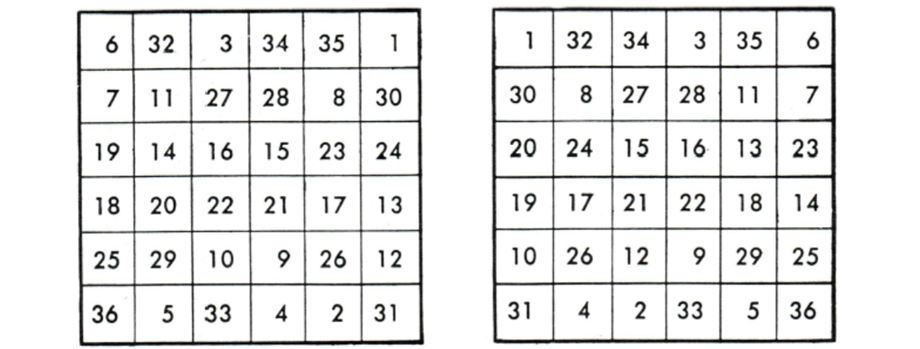
Diagram of mystic numbers.
These are two astrological charts pagan high priests used to predict certain future events. Any direction the columns are added, they will add to 111. There are six spaces, and 6 x 111=666. Any direction the numbers (1 to 36) are added together, the numbers of both charts will add to 666.
The Lord Himself clearly foretold what would happen to all astrologers, sorcerers, and all those who seek and trust their counsels. As written in Isaiah 47:13–14 (KJV): “Thou art wearied in the multitude of thy counsels. Let now the astrologers, the stargazers, the monthly prognosticators, stand up, and save thee from these things that shall come upon thee. Behold, they shall be as stubble; the fire shall burn them; they shall not deliver themselves from the power of the flame: there shall not be a coal to warm at, nor fire to sit before it.”
It should be noted that some of the details discussed above can be found in the book titled “The Antichrist 666 by W. J. Sutton. This is the revised edition, edited by Roy Allan Anderson and published by TEACH Services, Inc., in 2021”. The book provides additional background information on the origin and interpretation of the number 666.
2.THE NUMBER OF THE BEAST
In Revelation 13:18, the phrase “number of a man” indicates that the beast represents human systems or human authority. Additionally, 666 can symbolize arrogance and pride—humans attempting to exalt themselves above God. Just as Lucifer sought to “be like God,” the beast embodies human ambition, control, and defiance of God.
Revelation 13:4–9 (KJV):
- And they worshipped the dragon which gave power unto the beast: and they worshipped the beast, saying, Who is like unto the beast? who is able to make war with him?
- And there was given unto him a mouth speaking great things and blasphemies; and power was given unto him to continue forty and two months.
- And he opened his mouth in blasphemy against God, to blaspheme his name, and his tabernacle, and them that dwell in heaven.
- And it was given unto him to make war with the saints, and to overcome them: and power was given him over all kindreds, and tongues, and nations.
- And all that dwell upon the earth shall worship him, whose names are not written in the book of life of the Lamb slain from the foundation of the world.
- If any man have an ear, let him hear.
Revelation 13:18 (KJV):
“Here is wisdom. Let him that hath understanding count the number of the beast: for it is the number of a man; and his number is Six hundred threescore and six.”
This verse introduces the famous number 666, described as the “number of a man,” and calls for discernment and understanding to interpret its meaning. Known as the Number of the Beast, 666 is a symbolic number mentioned in Revelation 13:18 and carries profound spiritual and prophetic significance in the Bible.
This number of a man, 666, in Revelation 13:18 should not be viewed as a “triple six” representing a satanic trinity. This is because the number 666 in Revelation 13:18 is not written as three Arabic numerals (6-6-6), but rather in Greek numerical form using three letters of the alphabet: chi, xi and stigma.
Thus, the Greek letters chi, xi, and stigma together represent six hundred and sixty-six, not three separate sixes. In that case, the “Triple Six Theory” is not a correct explanation of the “number of a man” (arithmos anthrōpou)—six hundred and sixty-six—in Revelation 13:18.6
Stigma (ϛ) is a now obsolete Greek character that developed later as a ligature of sigma and tau (στ) and was used in the Greek numeral system to represent the value 6. In the context of Revelation 13:18, the number 666 is written in Greek as χξϛ (chi–xi–stigma), where chi equals 600, xi equals 60, and stigma represents 6. Thus, the passage uses this numerical notation to express 666. Strong’s Concordance (G5516) refers to this form, identifying χξϛ as the Greek numeral representation of 666 found in the text.
To understand Revelation 13 more fully, we need to refer back to Daniel 7 and compare the prophetic symbols. John describes the Antichrist as both a beast and a man (Revelation 13:18). In Daniel 7:17, 24, a beast is explicitly identified as a kingdom. By comparing Daniel and Revelation, theologians emphasize that the beast represents both prophetic symbols of earthly power and a corrupt religious system.
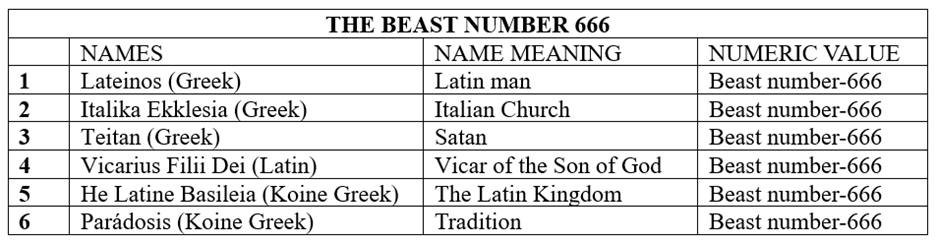
The Romans worshipped the sun under deities such as Sol and, later, Sol Invictus, who represented the power, permanence, and divine authority of the sun. Saturn was primarily a god of agriculture, time, and renewal, later identified with Cronus. The name Lateinos, discussed by Irenaeus in Against Heresies, is a numerological interpretation of 666; this Greek name “Lateinos” (meaning “Latin man” or “the Roman”) was associated with Latin or Roman identity.
In biblical prophecy studies, “Lateinos” is often cited as the Greek name for the Roman Empire or the “beast” power in Revelation. If you assign numerical values to the letters of the name “Lateinos” using the ancient Greek system of gematria (where letters represent numbers), it totals 666.
Using the Greek system of isopsephy (Greek gematria). Each Greek letter has a numeric value. The name “Lateinos” in Greek is written Λατεινος.
Here’s the numeric assignment:
- Λ (Lambda) = 30
- Α (Alpha) = 1
- Τ (Tau) = 300
- Ε (Epsilon) = 5
- Ι (Iota) = 10
- Ν (Nu) = 50
- Ο (Omicron) = 70
- Σ (Sigma) = 200
Adding these step by step gives a total of 666. This demonstrates the connection scholars draw between the name Lateinos and the famous number in Revelation 13:18.
In the Aeneid by Virgil, written during the late 1st century BCE in the reign of Augustus, Latinus is a king of Latium (king of the Latins or Romans). The Aeneid reflects the political and cultural ideals of the early Roman Empire, especially Augustus’ vision of Rome’s divine origins. At this time, divine or noble figures are described with luminous halos, radiant glory encircling the head, or dignity.
The halo (nimbus) seen in Christian art—especially in the Roman Catholic tradition—developed centuries later and was directly influenced by Greco-Roman artistic conventions used for gods, emperors, and personifications (including solar deities such as Sol Invictus) as noted in The Oxford Dictionary of Christian Art and Architecture, this depiction signified divinity, authority, and transcendence. Similarly, Early Christian Art and Architecture explains that early Christian artists adopted and adapted imperial and pagan artistic motifs—including the halo—to express the sanctity and elevated status of Christ and the saints .7-9
In the early Roman Empire, emperors adopted the radiate crown (a spiked halo), which was not merely decorative but symbolized the sun, reflecting associations with solar worship and conveying ideas of divinity, eternity, and celestial origin—thus emphasizing the sacred and exalted nature of imperial ancestry in Roman imagination and myth.
Ancient Mesopotamian cultures (where Nimrod is said to have ruled) practiced sun worship. The sun god Shamash was associated with justice and divine authority. Kings were often portrayed as having divine or solar connections. Shamash was the god of the sun, as well as of justice, law, and righteousness—a divine judge who “sees everything” because the sun illuminates all, especially among the Akkadians and Babylonians. He was commonly associated with a solar disk with rays, a saw-like blade, and radiance or beams of light. This symbolism influenced later imagery of divine kingship, radiant halos in art, and the idea of rulers reflecting divine light.
In Ancient Egypt, pharaohs were closely associated with the sun god Ra, and artistic depictions often showed a solar disk above the ruler’s head, sometimes encircled by a cobra (uraeus), symbolizing divine kingship and cosmic authority. In Ancient Greece, the sun god Helios was portrayed with a radiant crown of sun rays, an image that reflected his role as the personification of the sun and influenced later artistic traditions of depicting divine or semi-divine figures with luminous or radiant head adornments.
A luminous halo or sunbeams encircling the head represented a direct connection to the Sun, sun worship, and astrology. Satan uses not only religion to deceive, but also the arts. Simply by looking at the Roman Catholic army (the Jesuits) logo, you will see sunbeams encircling the letters “IHS.” Paintings of the Virgin Mary are often depicted surrounded by the sun or a sun-like radiance. Paintings of Jesus are depicted strikingly like pagan sun gods—with a radiant halo or sunbeams encircling His head. This artistic imagery, borrowed from earlier pagan traditions, links the worship of Christ to the symbolism of the sun, reinforcing the spiritual deception and sun worship in today’s papal system.
The terms “beast” (Revelation 13:1–2, 5–7; 11:2) and “little horn” (Daniel 7:8, 21, 24–25) share the same biblical characteristics and represent the same authority. The authors of Revelation 13 and Daniel 7 provide detailed explanations of the word “beast” and its prophetic significance, demonstrating the continuity of God’s message throughout Scripture. Both the “little horn” and the “beast” hold great meaning for faithful Christians (Rev 14:12) and the heavenly hosts. Throughout the Bible and Protestant history, the beast has been understood to represent the papacy, the governing authority of the Roman Catholic Church. Therefore, the “little horn” also represents the papacy.
To understand how the mysterious number of doom (666) is applied to the little horn and the beast of Revelation 13, we must examine the two controlling powers. First, the “invisible head,” which represents the spiritual power behind the beast and the little horn that opposes God. Second, the beast and the little horn themselves, which appear as earthly religious-political powers. By studying these powers, we gain insight into the origin of blasphemy, the persecution of the saints, and the reason why 666—the number of man and imperfection—is associated with them.
The Greek name for Satan is Τείταν (transliterated as Teitan). In the system of Greek isopsephy (where letters have numerical values), each Greek letter corresponds to a number. Here’s the breakdown:
Greek letters in τείταν (Teitan):
- Τ (Tau) = 300
- ε (Epsilon) = 5
- ι (Iota) = 10
- τ (Tau) = 300
- α (Alpha) = 1
- ν (Nu) = 50
So, in Greek numerology, the name Teitan (Τείταν) has the numerical value 666, which is interpreted symbolically as representing imperfection, rebellion, and evil. This is Satan`s number.
The Greek name for Jesus is Ιησούς (transliterated as Iēsous or IESOUS). In the system of Greek isopsephy (where letters have numerical values), each Greek letter corresponds to a number. Here’s the breakdown:
Greek letters in Ιησούς (Iēsous)
- Ι (Iota) = 10
- η (Eta) = 8
- σ (Sigma) = 200
- ο (Omicron) = 70
- ύ (Upsilon) = 400
- ς (Sigma) = 200
Total value: 10 + 8 + 200 + 70 + 400 + 200 = 888
The name Jesus above adds up to the number 888.
The Greek name for the “Italian Church” is Ἰταλικὰ Ἐκκλησία (transliterated as Italika Ekklesia).10 Using biblical prophetic symbolism, the Italian Church can also be called “the Little Horn Church” or “Spiritual Babylon.” In the system of Greek isopsephy (where letters have numerical values), each Greek letter corresponds to a number. Here’s the breakdown.
Greek letters Ἰταλικὰ Ἐκκλησία (Italika Ekklesia)
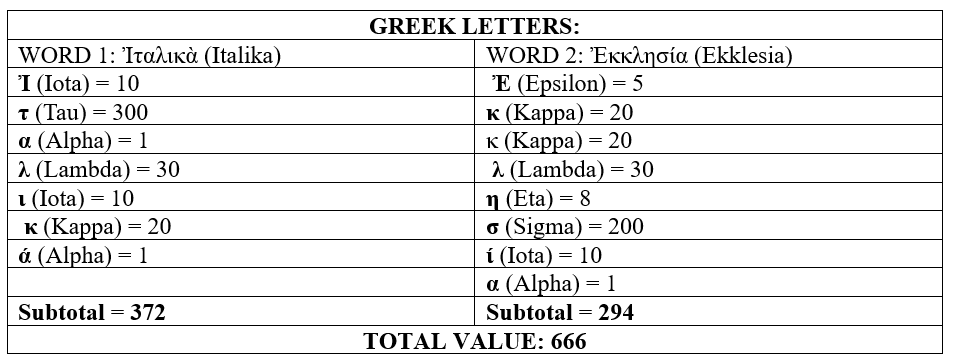
So, in Greek numerology, the name Italika Ekklesia (Ἰταλικὰ Ἐκκλησία) has the numerical value 666, which is interpreted symbolically as representing imperfection, rebellion, and evil—the number associated with the Little Horn, Satan, and the beast in Revelation.
The Latin name for the Pope is Vicarius Filii Dei (which means “Vicar of the Son of God”). In the system of Roman numerals (where certain letters have numerical values), each Roman-numeral letter corresponds to a number. Here’s the breakdown:
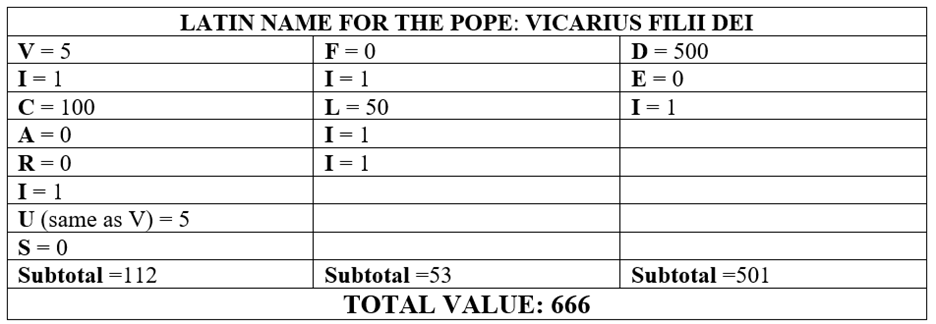
In the Roman-numeral interpretation, the name Vicarius Filii Dei has the numerical value 666. Vicarius Filii Dei is an official title of the Pope. The word “Pope” comes from the Latin papa, which translates into English as “Father.” Remember, this is the number of the Antichrist, the number of the beast, and the number of Satan.
Some Catholics claim that the title Vicarius Filii Dei is an anti-Catholic fabrication—a complete invention that was never used by the Catholic Church. One example of this claim appeared online in Catholic Envoy Magazine in an article by Patrick Madrid (see “Fiction 5”). Another Catholic apologist, Karl Keating of the organization Catholic Answers, made a similar claim in an article titled Pope Fiction and during a debate in the fall of 1989 with Jose Ventilacion of Iglesia ni Cristo.
Some people have claimed that this number refers to Caesar Nero. They say the number is obtained by calculating, through gematria, the words NERON KAISAR (in Hebrew), NERO KAISAR (in Hebrew), or KAISAR THEOS (in Greek).
However, we should understand that the number 666 is not the only sign used to identify the Antichrist, who is represented as the beast and the little horn. It is only one of nine distinctive biblical featuresof the Antichrist. While this number is biblical and important for identifying the Antichrist, it cannot serve as a single identifier; it must be considered together with the other eight biblical features to accurately recognize the Antichrist
We should also understand that this number could correspond to the numerical value of many names—even yours, your friend’s, or that of an institution. However, this alone does not make a person or institution the Antichrist. The name must also fulfill the other eight biblical characteristics before it can truly be associated with the Antichrist.
Emperor Nero, who persecuted Christians, is not automatically the biblical Antichrist merely because his name can be calculated as 666. The same applies to other emperors, such as Domitian or Diocletian, who were also notorious for persecuting Christians, or to any ruler who claimed to be worshiped as a god. The number alone is not sufficient; the full set of nine biblical criteria must be met for someone or authority to be identified as the Antichrist
When we speak about the “little horn” in Daniel or the beast in the Book of Revelation, we are speaking about our own time—beginning from the end of the sixth century (around A.D. 538). We are not speaking about the periods of Babylon, Medo-Persia, Greece, or the Roman Empire, because those kingdoms have already passed. According to Scripture, the little horn—the Antichrist—exists, has existed for centuries, and is still present today. His destruction will take place at the second coming of Jesus Christ (2Thessalonians 2:2–4; read also 2:8–10).
The Book of Revelation was originally written in Greek, specifically in a form called Koine Greek (not classical Greek). This linguistic context helps explain both its audience and its style, as it was addressed to early Christian communities who were familiar with symbolic and apocalyptic forms of writing. Revelation 13:18 calls for discernment and calculation, encouraging the reader to “count the number of the beast,” which implies interpretation rather than a purely literal reading.
It should be noted that nowhere in Revelation, or in the entire Bible, is this calculation of the number of man is explicitly limited to its original historical context alone. John writes to Greek-speaking Christian communities in Asia Minor, addressing their immediate circumstances under Roman rule, yet the message is also presented as having a broader, universal application to future readers. As such, it is one of the few biblical passages that appears to require understanding both within its original setting and in its unfolding significance over time. The original language and historical context should not be seen as restricting its interpretation or limiting its theological or symbolic meaning for us today.
If you carefully read Revelation 13:16–18, there are three important elements concerning the beast and the Antichrist:
Revelation 13:16–18 (KJV)
16. And he causeth all, both small and great, rich and poor, free and bond, to receive a mark in their right hand, or in their foreheads:
17. And that no man might buy or sell, save he that had the mark, or the name of the beast, or the number of his name.
18. Here is wisdom. Let him that hath understanding count the number of the beast: for it is the number of a man; and his number is Six hundred threescore and six.
Using prophetic symbolism from the Bible, we find three main points:
- The mark of the beast – [Sunday]
- The name of the beast – [Vicar of the Son of God]
- The number of the name of the beast – [666]
3.VICARIUS FILII DEI IN HISTORICAL CONTEXT.
This connection between the name Vicarius Filii Dei (meaning “Vicar of the Son of God”) and the number 666 was first identified by Andreas Helwig in 1612 in his book The Roman Antichrist. Helwig used Latin numerology: by taking the letters in VICARIUS FILII DEI that correspond to Roman numerals and adding their numeric values, the total comes to 666. This method of assigning numeric values to letters is known as isopsephy or gematria in classical traditions.
Lateinos and Ekklesia Italika are cited as possible solutions by Johannes Gerhard (1582–1637), a Lutheran, in his Adnotationes in Apocalypsin (page 110). Vicarius Filii Dei and Dux Cleri are cited by the rector of Berlin, Andreas Helwig (1572–1643), in his Antichristus Romanus, in proprio suo nomine, numerum illum Apocalypticum (DCLXVI) continente proditus, published in 1612 in Wittenberg. This relationship of 666 in Greek, Latin, and Hebrew is only one relatively small, yet important, indicator that the Papacy is the Antichrist and the beast from the sea described in Revelation 13.
An objection has been raised that the method of gematria used above to calculate the Roman numeral value of phrases is incorrect. It is argued that the word VICARIUS must be calculated with letters grouped as follows: VI = 6, C = 100, A = 0, R = 0, IU = 4, S = 0, giving a total of only 110 instead of 112. This, however, is patently incorrect. The value of each individual letter must be added to yield the total value. It is entirely irrelevant whether adjacent letters can be combined to form groups with a value. The assertion that letters must be grouped is simply nonsense.
If one looks up word 473 in Strong’s Greek Dictionary, it is evident that the term ‘anti’ is often used to denote substitution (“in place of”). Strong’s defines ‘anti’ (antí, Strong’s 473) as ‘a primary particle; opposite, i.e., instead of or because of (rarely in addition to): for, in the room of.’ It is frequently used in compound words to convey ideas such as contrast, requital, substitution, and correspondence.
The Greek term “antichristos” (Antichrist, Strong’s 500) can mean both “in place of Christ” the Son of God, and “against Christ.” Therefore, in academic or theological literature, it is often understood and used in both senses rather than being limited only to opposition. Anyway, the Papacy and its priestly system embody both elements, as they are both a substitution for and an opposition to Jesus Christ, the Son of God.
A Vicar General is defined in the 1994 Catholic Almanac on page 330 as “a priest or bishop appointed by the bishop of a diocese to serve as his deputy, with ordinary executive power, in the administration of the diocese.” So, a vicar serves in the place of (substituting for) the bishop, and assumes his power of office for certain duties. So, the Papal title of VICAR OF CHRIST which in Latin is VICARIUS CHRISTI, means a SUBSTITUTE FOR CHRIST, which is synonymous with Antichrist, i.e., assuming the power of God on earth! This blasphemous claim is made repeatedly by various Popes and is the very foundation of Roman Catholicism and its Papacy.
1.Vicar of Christ
“Vicar of Christ” is a title used almost exclusively of the Bishop of Rome as the successor of Peter and, therefore, the one in the Church who particularly takes the place of Christ. However, it has also been applied more broadly to bishops in general and even to priests. The term was first used by the Roman Synod of A.D. 495 to refer to Pope Gelasius and later became more common in Roman curial usage during the pontificate of Pope Eugene III (1145–1153). Pope Innocent III (1198–1216) explicitly asserted that the Pope is the Vicar of Christ.11
The title was further defined at the Council of Florence in the Decree for the Greeks (1439) and at Vatican Council I in Pastor Aeternus (1870). The Second Vatican Council, in Lumen Gentium (n. 27), refers to bishops in general as “vicars and legates of Christ.” In this broader sense, all bishops are considered vicars of Christ for their local churches in their ministerial roles as priest, prophet, and king, just as the Pope is for the universal Church. The title also signifies that their authority in the Church is exercised not by delegation from any other person but directly from Christ Himself. 11
We likewise define that the Holy Apostolic See and the Roman Pontiff hold primacy throughout the entire world, and that the Roman Pontiff is the successor of blessed Peter, the chief of the Apostles, and the true Vicar of Christ, and that he is the head of the entire Church and the father and teacher of all Christians; and that full power was given to him in blessed Peter by Our Lord Jesus Christ to feed, rule, and govern the universal Church, as is contained in the acts of the ecumenical councils and in the sacred canons.12
Academic, theological, and official Catholic sources consistently affirm that Vicarius Christi is a correct, historically grounded, and doctrinally significant title of the pope, expressing his role as Christ’s representative and visible head of the Church on earth. “Vicarius Christi” is a Latin phrase for“Vicar of Christ”meaning someone who substitutes himself for Jesus Christ or someone who takes the place of Christ. Vicarius Christi (“Vicar of Christ”) being the official principal papal title, this means that the Pope takes the place of Christ, acts in the place of Christ or a representative of Christ.
The Bible clearly affirms that Jesus Christ is the Son of God in many passages. In Matthew 16:16, it is written, “You are the Christ, the Son of the living God.” Similarly, John 20:31 states, “These are written that you may believe that Jesus is the Christ, the Son of God.” Hebrews 4:14 refers to “Jesus the Son of God,” and 1 John 4:15 declares, “Whoever confesses that Jesus is the Son of God, God abides in him.”
As the Pope is the Vicar of Christ (Vicarius Christi), according to official Roman Catholic sources, and Jesus Christ is the “Son of God,” according to the Holy Scriptures, then this would mean that the Pope is the “Vicar of the Son of God.” Thus, the Pope would be described as the Vicar of the Son of God, which in Latin is Vicarius Filii Dei. We should also remember that the word “Antichrist” is correctly interpreted as someone who substitutes himself for Jesus Christ, or acts instead of Jesus Christ, the Son of God.
2.Vicar of Jesus Christ
Pope Innocent III popularized the title “Vicar of Jesus Christ”. In Inter corporalia, he claimed that as the Vicar of Jesus Christ, only the Roman Pontiff could remove or transfer bishops, because he acted not with human, but with divine power and authority reserved for the Roman Pontiff alone. 13
In Licet in tantum, Pope Innocent III stated that he was the successor of Peter and Vicar of Jesus Christ: For instance, man cannot overthrow the bond of a legitimate marriage of husband and wife, the Lord saying in the Gospel, That which God hath joined together, let not man put asunder (Matt. xix,6): so also is the spiritual covenant of marriage, which is between the bishop and the church, which begins in the election, is ratified in confirmation and in the consecration is completed, it is understood, cannot be dissolved without the authority of he who is the successor of Peter, and the vicar of Jesus Christ.14
English translation of the Latin text: “In the militant Church, which resembleth the triumphant, there is one moderator and judge of all, the Vicar of Jesus Christ, from whom, as from the head, all power and authority is derived to the subject members; and this power doth immediately flow into it from Christ the Lord.” 15
English translation of the Latin text: “In one flock the fold was contained, even as at the present day they are contained, that there is one bridal chamber of Christ, one bride, one fold, and one shepherd, and one overseer of all the bishops, the Bishop of Rome, the successor of blessed Peter, and the Vicar of Jesus Christ.” 16
Because the Pope is the Vicar of Jesus Christ, according to official references, for example: (1) Holy See. Annuario Pontificio. Vatican City: Libreria Editrice Vaticana, annual publication (e.g., 2012 ed., p. 23); (2) Second Vatican Council. Lumen Gentium: Dogmatic Constitution on the Church. Vatican City: Libreria Editrice Vaticana, 1964, §§22–27; (3) Attwater, Donald, and Catherine Rachel John. A Catholic Dictionary. 3rd ed. London: Cassell, 1993, pp. 484–485; (4) Marthaler, Berard L., ed. New Catholic Encyclopedia. 2nd ed. Detroit: Gale, 2003, s.v. “Pope” / “Vicar of Christ”; and (5) Fanning, William. “Vicar of Christ.” In The Catholic Encyclopedia. New York: Robert Appleton Company, 1912; and since Jesus Christ is the “Son of God,” according to the Bible (Matthew 3:17, 16:16; John 1:34, 3:16, 20:31; Romans 1:4; and 1 John 4:15), then this would mean that the Pope is the “Vicar of the Son of God.” Thus, the Pope would be described as the Vicar of the Son of God, which in Latin is Vicarius Filii Dei.
3.Vicarius Filii Dei
A standard quotation (English translation of the Latin text)
“After the approval of God’s chief Apostle, it is evident that the Roman Emperor is the lord or universal protector of Christians; and that supreme power is from God, and next to it the Pope, who is the Vicar of the Son of God.” 17
A standard quotation (English translation of the Latin text)
“With this notwithstanding, the power of confirmation has always been accorded to the Lord Pope, who is the Vicar of the Son of God; notwithstanding, because this (papal confirmation) is not known when Emperors have previously been faithless.” 17
A standard quotation (English translation of the Latin text)
“And if the Pope cannot order nor dispense contrary to the law of God of the Old and New Testament, even though he is the Vicar of Christ, the Almighty Son of God, according to this: ‘Thou art Peter, etc., I will give thee the keys of the kingdom of heaven,’ the Emperor is much less able to dispense contrary to the Old and New Testament…” 18
A standard quotation(English translation of the Latin text)
“And as to the first point, since the Pope is the Vicar of the Son of God, just as God, who acts through created secondary causes, can do all things immediately by Himself, so the Pope likewise has, at least as regards jurisdictional power, the same capacity in his own order. For as he governs all the faithful through the ministers of the Church, so he can also govern them immediately by himself.” 18
Bureau of Information: Our Sunday Visitor is a real Catholic newspaper founded in the United States in 1912. It published a “Bureau of Information” question-and-answer section in the early 20th century. The “Bureau of Information” column answered readers’ questions in a simplified form and reflected Roman Catholic editorial explanations and opinions on topics related to the papacy and the Church. This source show that the title Vicarius Filii Dei was, and is, associated with Roman Catholic popes.
The popes were described and referred to by the title “Vicarius Filii Dei” (Vicar of the Son of God) for about six centuries, at least from the 11th to the 16th century. Several popes were described and called by this name. During this period, the title Vicarius Filii Dei was not denied as applying to the popes and was understood as a designation of the Roman Catholic Church pope`s. Even so, the title continued to appear in Catholic canon law and other Catholic publications for additional centuries. Vicarius Filii Dei represents an expanded form of the shorter papal title“Vicarius Christi”. Yes, Vicarius Christi is certainly the shorter form of Vicarius Filii Dei.
4.The Donation of Constantine
It is said that the Donation of Constantine is the most famous forgery in European history and was later associated with the Pseudo-Isidorian Decretals, which appeared in the 9th century (c. 847–853). The forger is thought by some to have been Johannes Hymonides (John the Deacon). The Pseudo-Isidorian Decretals consist of fictitious letters attributed to early popes—from Pope Clement I (c. A.D. 100) to Pope Gregory I (A.D. 600)—and were compiled under the name Isidore Mercator in the 9th century; since the rise of scholarly criticism in the 15th century, these documents have been widely recognized as forgeries and are therefore called the “Pseudo-Isidorian Decretals” or “False Decretals” to acknowledge their fraudulent nature.
Johannes Hymonides was a Roman cleric, writer, and librarian of the Church. He served in Rome during the time of Pope John VIII (pontificate: 872–882). He is best known for writing a biography of Pope Gregory I, an important early pope (590–604). This work, often titled “Life of Gregory the Great”, drew on earlier records and helped preserve valuable historical information about Gregory’s life, character, and leadership. Johannes Hymonides was part of the intellectual circle of the Carolingian era, contributing to the preservation and transmission of church history and learning. A key feature of this period was the Carolingian Renaissance—a revival of learning and culture.
The donation reads in part as follows in Latin: (caps added for emphasis)
Latin “… ut sicut B. Petrus in terris VICARIUS FILII DEI esse videtur constitutus, ita et Pontifices, qui ipsius principis apostolorum gerunt vices, principatus potestatem amplius quam terrena imperialis nostrae serenitatis mansuetudo habere videtur, conscessam a nobis nostroque imperio obtineant…”
English “… as the Blessed Peter is seen to have been constituted vicar of the Son of God on the earth, so the Pontiffs who are the representatives of that same chief of the apostles, should obtain from us and our empire the power of a supremacy greater than the clemency of our earthly imperial serenity is seen to have conceded to it…”
The Donation of Constantine was used by many Popes (at least ten) as proof that they had political authority over Rome and the territories later called the Papal States, which covered much of Italy. In 1440, the scholar Laurentius Valla showed that this document was not genuine but a forgery. Despite this discovery, the Vatican opposed Valla’s work and included it in the Index Librorum Prohibitorum in 1559 (a list of banned books first issued in 1559). Even by around 1580, official Church law collections like the Corpus Juris Canonici still treated related documents, such as the False Decretals, as if they were genuine and authentic.
Lorenzo Valla (in Latin, Laurentius Valla, 1407–1457) was an Italian scholar, humanist, and philologist. His most famous achievement was proving that the Donation of Constantine was a forgery. Valla demonstrated this by showing that the Latin style and vocabulary in the document did not belong to the time of Emperor Constantine the Great (4th century), but instead reflected much later medieval usage.
Despite the controversial nature of his findings, Valla eventually worked for the papal court under Pope Nicholas V (pontificate: 1447–1455), showing that his scholarship, though bold, was also respected. Valla was part of the broader movement of Renaissance humanism, which shifted focus from purely religious authority to human reason, classical learning, and the critical study of texts.
The Donation of Constantine was long regarded as a genuine document by the Roman Catholic Church and the papal system, particularly from the 9th to the 16th century, during which it was used to support claims of authority and legitimacy. The phrase “Vicarius Filii Dei” (“Vicar of the Son of God”), found in the document, was employed to support the claim that the pope, as the successor of Peter, possesses authority and supremacy exceeding that of the Roman emperor.
The Donation of Constantine played a significant role in shaping claims of papal authority and supremacy. It was only declared a forgery in the 15th century, amid growing opposition and criticism against the papacy, including interpretations identifying the papacy with the beast of Revelation.
It should be remembered that it was during the late Middle Ages (14th century) that the first strong criticisms of the papal system as the Antichrist and the Beast began to appear. Biblical scholars started to make a more direct connection between the Beast of Revelation and the papacy as the Antichrist. During the Reformation era(16th century), this identification became clear and widespread. Major Reformers explicitly connected the Beast of Revelation with the Antichrist and the papacy. Key figures include John Wycliffe (c. 1328–1384), Jan Hus (c. 1372–1415), Martin Luther (1483–1546)—who in the 1520s–1530s openly declared the Pope to be the Antichrist—and John Calvin (1509–1564).
5.Vicar of Jesus Christ, the Son of God
Pope Nicholas IV (reigned 1288–1292) did issue letters to various rulers, including Mongol and Tatar leaders. These letters are preserved in the register collections of Nicholas IV (1288–1292) and generally focus on diplomacy, missionary activity, and possible alliances against Muslim powers. They are confirmed in modern scholarly editions of his registers, such as Les Registres de Nicolas IV, and in summaries of his pontificate.
The phrase “Vicarius enim Jesu Christi Filii Dei est” translates into English as “For he is the Vicar of Jesus Christ, the Son of God.” It is commonly traced to a printed compilation of papal documents rather than to a modern critical edition of Nicholas IV’s original registers. The main cited source is Aloysius Guerra (ed.), Pontificiarum Constitutionum… (Venice, 1772), vol. 2, p. 456. This 18th-century collection reproduces a letter attributed to Pope Nicholas IV (1289), addressed to a Mongol or Tatar ruler, in which this wording appears in Latin
Historically, the title “Vicar of Christ” is well-attested and was commonly used for popes by the medieval period, including the 13th century. Grammatically and conceptually, the two phrases “Vicar of Jesus Christ, Son of God” and “Vicar of the Son of God” are very close and essentially the same. “Vicar of Jesus Christ, Son of God” explicitly names Jesus Christ and identifies Him as the Son of God. “Vicar of the Son of God” refers to the same person (Jesus Christ) in a more indirect and descriptive way. Thus, they are functionally equivalent in reference, even if the wording is slightly different. The phrase “Vicar of the Son of God” is the same as “Vicarius Filii Dei” in Latin.
In mainstream Christianity, the central belief is that Jesus Christ is God the Son, the second Person of the Trinity. This means there is one God (Deuteronomy 6:4; Isaiah 44:6; Isaiah 45:5; Mark 12:29; 1 Timothy 2:5; and Ephesians 4:6), and God exists as three Persons: Father, Son, and Holy Spirit (1 John 5:7–8; Matthew 28:19; and 2 Corinthians 13:14). This belief is based on interpretations of passages such as John 1:1 (“the Word was God”), John 10:30 (“I and the Father are one”), John 20:28 (“Thomas answered him, ‘My Lord and my God!’”), and Titus 2:13 (“Our great God and Savior, Jesus Christ”).
Calling any human a “Vicar of God on earth” is seriously offensive to the authority of God and Christ. Jesus Christ is the only true Head and mediator (1 Timothy 2:5; Ephesians 5:23); assigning a human the role of God’s vicar is usurping a role that belongs exclusively to Christ. Christ is the supreme authority over the Church (Colossians 1:18). All authority has been given to Christ alone (Matthew 28:18). God has placed everything under Christ’s authority for the Church (Ephesians 1:22–23), and Christ is the Chief Shepherd, not a human leader (1 Peter 5:4). Christ alone holds supreme authority, leadership, and mediation over the Church; no human can share or replace that role.
Even if intended symbolically, it still crosses the line into blasphemy. Christ’s work and presence are fully sufficient for the Church. The idea of a “visible head” or stand-in for God denies the completeness of Christ’s role as King and High Priest. A central biblical principle is that all believers have direct access to God through Christ—no single human stands above others as God’s representative in that sense. A title like “Vicar of God” is not only blasphemous but also creates an unbiblical spiritual hierarchy
6.A Treatise on Ecclesiastical Authority
Augustinus Triumphus (Latin: Augustinus de Ancona, also known as Augustine of Ancona) was a medieval Catholic theologian and canon lawyer who lived circa 1243–1328. He was expressly commissioned by Pope John XXII to produce a work that would set forth and defend the ecclesiastical and temporal authority of the papacy. The result was Summa de potestate ecclesiastica, which was completed in 1320 and dedicated to the same pope, and is considered the high-water mark of papal pretensions. In this extremely important and official document of the Roman Catholic Church, Augustinus Triumphus applies the phrases “Vicarius Christi” and “Vicarius Filii Dei” to the papacy.
The Summa de potestate ecclesiastica of Augustinus Triumphus has been described as ‘one of the half dozen most influential and most important books ever written’ on the nature of the papal supremacy in the Middle Ages.19-20
Augustinus’ Summa de potestate ecclesiastica is an extensive treatise, comprising over 600 double-column pages in the early printed editions. It is structured into 112 questions, divided into three major parts. At least twenty-four complete manuscripts of the work are extant, along with a further fifteen containing fragments. The Summa was published in five editions during the fifteenth century, followed by four successive editions in Rome between 1582 and 1585, the latter being the final printed edition of Augustinus’ work.21
Read the following English translation quotes from the Augustinus Triumphus, Summa de potestate ecclesiastica corresponding to their Latin questions.
Question 6, Ad 1 (English translation from Latin).
The second argument is taken from the part of the Pope: only the Pope is said to be the Vicar of God, because whatever is bound or loosed through him is accounted as bound and loosed through God Himself. Therefore, the opinion of the Pope and the opinion of God is one opinion, just as the opinion of the Pope and his hearer is one. And since an appeal is always made from the lesser judge to the higher, as no one is greater than himself, so no appeal holds made from the Pope to God, because there is one consistory of the Pope and of God, of which the Pope himself is the key‑bearer and doorkeeper. Therefore, no one can appeal from the Pope to God, just as no one can enter into the consistory of God except through the Pope, who is the key‑bearer and doorkeeper of the consistory of eternal life
Question 37 Ad 3. (English translation from Latin).
“Constantine made such a transfer by the authority of the supreme pontiff, who, as the vicar of God’s Son, the heavenly emperor, holds universal jurisdiction over all kingdoms and empires”.
Question 37 Ad 5. (English translation from Latin).
“Yet nevertheless, in instituting changes of rulers, there can be no doubt that the supreme pontiff, whom Constantine firmly confesses to be the vicar of God’s Son, the commander in chief, is able to select whomever and from wherever he pleases to aid and defend the Church”.
Question 45 Ad 2. (Latin fragment as commonly cited)
Latin “… quòd Papa vicarius Iesu Christi, vice Dei viventis, in toto orbe terrarum spiritualium, & temporalium habet universalum iurisdictionem: …”
English “… the fact is that the Pope, as the vicar of Jesus Christ, in the place of the living God, has universal spiritual and temporal jurisdiction over the entire globe of the earth: …”
Question 61 Ad 1 (Latin fragment as commonly cited)
Latin “Est enim ipse papa Dei filii vicarius.”
English “For the pope himself is the vicar of the Son of God.”
In terra pax hominibus: Pope Leo IX is historically documented to have officially sent a letter titled In terra pax hominibus (Latin: Peace on Earth to Men) around 1054 to Patriarch Michael I Cerularius of Constantinople and other Eastern leaders, asserting papal primacy. In this epistle, Leo quoted from the Donation of Constantine, which contains the phrase vicarius filii Dei (“vicar of the Son of God”), and reproduced those sections to argue for the primacy and authority of the See of Peter.
The historical letter In terra pax hominibus is preserved in several authoritative sources, including (1) Patrologia Latina, vol. 143, cols. 744B–769D, which serves as the principal Latin source for the complete text of the letter; (2) Sacrorum Conciliorum Nova Amplissima Collectio, vol. 19; and (3) Enchiridion Symbolorum (Denzinger), an authoritative Catholic compendium that reproduces portions of Pope Leo IX’s 1054 letter (Dz. 350–353), addressed to Michael I Cerularius, and records and summarizes the primacy arguments articulated therein.
From the first recorded use of the title Vicarius Filii Dei by a Pope in an official act in 1054 A.D. to the final printed edition of Augustinus Triumphus’ Summa de potestate ecclesiastica in Rome in 1585, a span of 531 years elapsed. During this period, the title and the concept it embodied—asserting the Pope as the vicar of the Son of God with both spiritual and temporal authority—were continuously referenced, debated, and reinforced in ecclesiastical, legal, and political contexts.
The Summa de potestate ecclesiastica by Augustinus Triumphus was accepted, disseminated, and used by the Catholic Church to reinforce the papacy’s claims, as it aligned with the Church’s official understanding of papal authority. Today, papal authority is exercised according to the 1983 Code of Canon Law, while the Summa de potestate ecclesiastica remains highly valuable for historical and theological scholarship, offering insights into medieval Church politics and the intellectual defense of papal authority.
The phrase and title “Vicarius Filii Dei” (“Vicar of the Son of God”), found in various official papal documents, was used up to the 16th century. The title was employed to support the claim that the pope, as the successor of Peter, possesses authority and supremacy exceeding that of the Roman emperor and acts in the place of Jesus Christ. Its use later declined due to clear and widespread criticism connecting it to the Beast of Revelation 13 and the papacy as the Antichrist. The phrase and title “Vicar of Christ,” which is conceptually and functionally the same as “Vicarius Filii Dei,” and the title “Pontifex Maximus” are still principal and official titles of the papacy up to date.
7.Recent work
From 2007 to 2011, Stephen D. Emse, Jerry A. Stevens, Michael Scheifler, and Edwin de Kock, conducted thorough new research to determine whether, and to what extent, Vicarius Filii Dei had been used as a papal title. The results of their research were incorporated in the book The Truth About 666 and the Story of the Great Apostasy (2011, 2013), by Edwin de Kock. Massive new evidence in Italian, Spanish, German, French, English, Portuguese, and Welsh sources revealed that for centuries, the title Vicarius Filii Dei was indeed ascribed to many popes.6
Summary of the two sections, “The Origin of the Number 666” and “The Number of the Beast”: The “number of a man,” 666, mentioned in Revelation 13:18, is understood as a mark of sun worship, a sign of pagan worship, a sign of false worship, Satan’s number, the beast’s number, the Antichrist’s number, and the papacy’s system number. This number symbolizes the convergence of spiritual deception, idolatry, and opposition to God, as represented in biblical prophecy.
4.THE TITTLE PONTIFEX MAXIMUS
The title Pontifex Maximus, which today is associated with the Roman Catholic Church and the office of the Pope, has deep roots in pre-Christian Roman religion. Its literal Latin meaning is “Greatest Bridge-Builder” (pons = bridge, facere = to make or build).
It’s one of the early titles used for the Pope. It was the official title of the highest priest in the Roman Empire, where it referred to the supreme authority over the pagan religious system of Rome.11 The Pontifex Maximus was the head of the college of pontiffs, the principal priestly body in Rome, whose responsibilities included:
- Overseeing religious rites and festivals dedicated to Roman deities.
- Maintaining the Roman calendar and determining sacred days.
- Presiding over ceremonies that legitimized the authority of the Roman state and its leaders.
In this role, the Pontifex Maximus served as a bridge between the divine and human realms, acting as the ultimate religious authority in Rome long before Christianity became the state religion.
The title embodied pagan cosmology and ritual power: it was associated with the mediation between gods and mortals and the supervision of sacred law. The office itself was inseparable from the structure of Roman polytheism, rooted in the worship of gods like Jupiter, Janus, and Vesta. The term “bridge-builder” reflected both literal functions (overseeing sacred bridges like the Pons Sublicius) and figurative religious authority, highlighting a connection with cosmic order and divine sanction.
Several prominent historical figures held the title Pontifex Maximus, the chief priest of ancient Rome. Julius Caesar was elected to this position in 63 BC and held it until his death in 44 BC. After him, Marcus Aemilius Lepidus assumed the role and retained it until his death in 12 BC. Following Lepidus, Augustus became Pontifex Maximus in 12 BC, further establishing the tradition of Roman emperors holding the title. This practice continued with Tiberius, who succeeded Augustus and maintained the integration of religious and imperial authority.
With the Christianization of the Roman Empire under Constantine and subsequent emperors, the title was gradually appropriated by Christian leaders. By the time of Pope Leo, I (also known as Leo the Great, c. 400–461 AD) and later pontiffs, Pontifex Maximus had become a papal title, effectively replacing its pagan associations with a Christian framework. Nevertheless, the continuity of the title illustrates how the Church absorbed Roman political and religious forms into its hierarchy; a process historians describe as “institutional inheritance” from the pagan past.
Other than this title, the Pope has held a number of titles throughout the centuries. One example in Latin is Dux Cleri, which means “Captain of the Clergy.” It emphasizes the Pope’s role as the spiritual head and guide of the ordained ministers of the Church.
Another important title is Servus Servorum Dei (“Servant of the Servants of God”), which is one of the most meaningful and enduring papal titles. This title appears in formal papal documents such as bulls and apostolic letters. For example, modern popes—including Pope John Paul II and Pope Francis—have used the title in their official Latin signatures, thereby reinforcing continuity with early Church tradition.22-24
From literature associated with the Papacy, the following statement is recorded in The World of the Vatican, p. 10:
In certain respects, the Pope himself appears to be the lineal descendant of the Caesars. A good deal of the cherished terminology of the Roman Catholic Church antedates the Christian era. For example, the title Pontifex Maximus, or Supreme Pontiff, which originally meant ‘Bridge Builder’ but now simply denotes the Pope, was used to describe the office of the head of pagan cults centuries before the Emperor Constantine the Great recognized Christianity as a legal religion. Julius Caesar, among other notable figures, was a Roman pontiff. So were Marcus Aemilius Lepidus and Augustus.
The expression ‘Roman Curia,’ which today refers to the Church’s headquarters in the Eternal City, originated in the early days of Ancient Rome. At that time, it referred to an assembly of tribes; later, during the Republic, it became almost a synonym for the Roman Senate.
The term ‘diocese,’ which today means the territory under a bishop’s jurisdiction, was originally an administrative division established by the Emperor Diocletian, who is also known for his persecution of Christians.”
In discussing the high priesthood of the cult of Janus in ancient Rome, Alexander Hislop attempts to trace the origin of the title “cardinal” to pre-Christian religious terminology. In his work The Two Babylons, he writes: “In the worship of Janus in Rome, the high priest had the title jus vertendi cardinis, which meant the power of turning the hinge or opening and shutting. The pagan high priest had a college of councillors who assisted him in temporal as well as religious matters. These were called ‘Cardinals,’ the priests of the ‘hinge.25
The backbone of the Roman Catholic Church and the papal system is entirely pagan in origin. It inherited structures, feasts, pagan symbols, names, and various pagan traditions. Although the Church claims that its authority was handed down from the Apostle Peter, based on Matthew 16:16–19, the reality is quite different.
5.NINE DISTINCT FEATURES OF THE ANTI-CHRIST
The terms “beast” (Revelation 13:1–2, 5–7, 18, 11:2) and “little horn” (Daniel 7:8, 21, 24–25) share the same biblical characteristics and represent the same authority. Throughout the Bible and Protestant history, the beast has been understood to represent the papacy, the governing authority of the Roman Catholic Church. Therefore, the “little horn” also represents the papacy.
Both the beast and the little horn originate within a broader geopolitical setting and are connected to ten horns. They speak blasphemous words, persecute the saints of God, exercise dominion for 1,260 years, and claim divine prerogatives. Ultimately, they are judged and destroyed by God because their power is temporary and ends in divine judgment. The beast of Revelation 13:18 is the little horn of Daniel 7:8, the little horn is the Antichrist, the man of sin, and the son of perdition described in 2 Thessalonians 2:3–4
Revelation 14 speaks about the first angel’s message (Rev. 14:6–7), the second angel’s message (Rev. 14:8), and the third angel’s message (Rev. 14:9–12). To understand these messages, it is necessary to know about Babylon. The Bible speaks of three kinds of Babylon: the ancient city, the Babylonian Empire, and spiritual Babylon.
Ancient City: The early root of the word “Babel” is found in Genesis 10 and 11, where it is associated with the Tower of Babel in the land of Shinar during the era of Nimrod (Genesis 10:8–12; 1 Chronicles 1:10).
Babylonian Empire: Jeremiah 50–51 and Daniel 2 describe the Babylonian Empire (also called the Chaldean Empire). Babylon continued its reign until 536 BC. Nebuchadnezzar, its greatest king, reigned during the days of Daniel. The prophet Isaiah portrayed this Babylon as a woman, “the lady of kingdoms” (Isaiah 47:1–5), who should be tender and delicate, but was not. This fallen literal Babylon (Daniel 5:25–28) is described as a city of pride and idolatry, a dwelling place of false deities, and a supporter of tyranny.
Spiritual Babylon: In Revelation 14:8, 16:19, 17:5, and 18:2, the word Babylon represents a religious system, a religious Babylon, or a rebellious church—the mother of harlots and abominations of the earth. The term Babylon, derived from Babel and signifying confusion, is applied in Scripture to the various forms of false or apostate religion. Throughout the Bible and Protestant history, Babylon has been understood as a symbol of the Roman Catholic Church (Rev. 13:1–10; 17:1–18; 18:1–10).
A Christian body whose leaders, at worst, reject the elements of Bible truth and persecute Christians who choose to believe and follow biblical truth. Babylon’s daughters are Protestant churches which, like the Roman Church, reject Bible truth and harass those who accept it (Rev. 17:1–6; Isaiah 4:1). The second angel’s message calls us to understand Babylon and to completely stay away from her Babylonian teachings.
In Revelation and prophecy, a woman represents the church. Let us read 2 Corinthians 11:2, Jeremiah 6:2, Ephesians 5:23–32, and Revelation 12:1, 17; 19:7–8. We find two women in Revelation, and these two symbolic women are diametrically opposite. The first woman (Revelation 12) represents those who have been God’s covenant people—the church of God—both in the Old Testament and the New Testament, the called-out servants of Christ: the pure woman, the pure church.
The second woman is represented as a harlot, a great city, and a rebellious church (Revelation 17). This harlot woman is a church, a religious system that was not, and is not, obedient to Christ.
Under the guidance of the Holy Spirit and through diligent Bible study alongside clear world history, Babylon represents the Roman Catholic Church. Here, we have seven (7) biblical characteristics that explain why the Roman Catholic Church is Babylon and the great city that reigns over the kings of the earth (Rev. 17:18). All seven characteristics must apply to the Roman Catholic Church, or to any other church (if any), for it to be identified as Babylon.
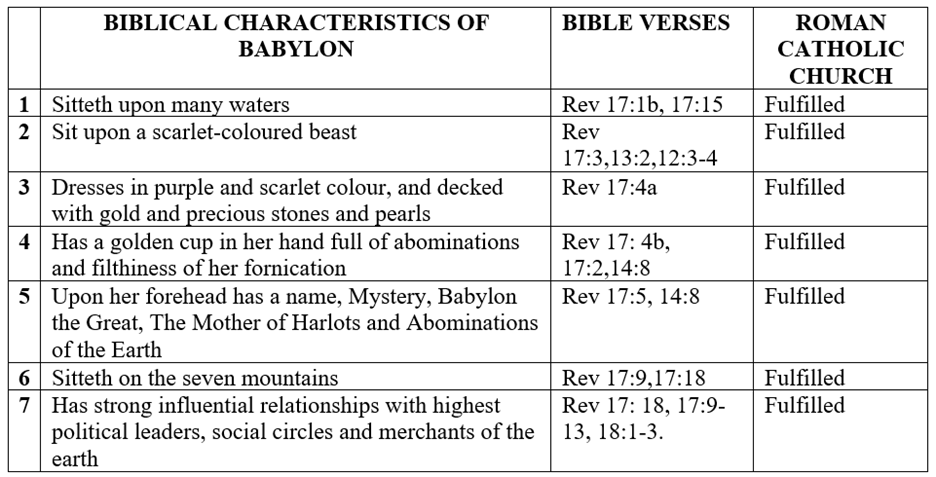
We need to research and study deeply each of the seven elements in the table above to understand why the Roman Catholic Church is spiritual Babylon. We should read the books of Daniel and Revelation in the New Testament. These two books complement each other in an extraordinary way and serve as sources of knowledge about the prophecies and history of this world.
By reading the holy scriptures with an open mind and in the presence of the Holy Spirit, we can identify nine intertwined biblical features of the beast in Revelation (Rev 13:18, 14:6–12), which show that the papal authority is the beast of Revelation. All nine biblical features must apply to the Papacy, or to any other authority (if any), for it to be considered the beast of Revelation.
Here are nine distinct biblical features of the Beast
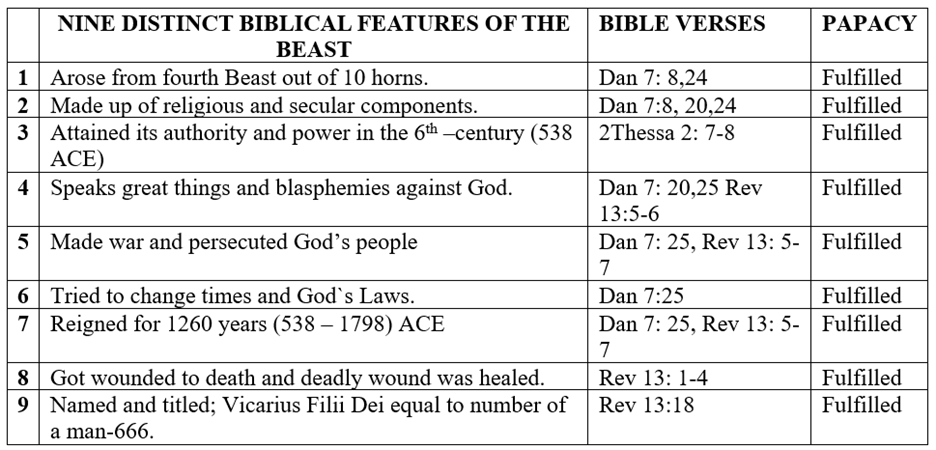
Again, we need to research and study each of the nine elements of this table deeply to understand why the Papacy is identified as the beast, the little horn and the Antichrist. Simply put, throughout Scriptures and world history, the Papacy is shown to fit all nine biblical features of the beast in Revelation 13s.
The staying power of the beast and its empire leads to the worship of both the dragon and the beast. The dragon is worshiped for giving authority to the beast, and the beast is worshiped because of its deception, endurance, infiltration, and influence. It is considered incomparable and omnipotent, like God (Ex. 15:11; Ps. 89:7). People worship the beast, believing it cannot be resisted or overcome, as has often been observed in history.
The beast comes out of the pagan Roman Empire, from among ten kingdoms. The beast does not rule by itself; it receives its power, throne, and authority from the dragon (Satan, Revelation 13:2). One of its heads is wounded and healed, which causes the whole world to wonder after the beast. It speaks against God’s name, His dwelling, and those who are in heaven. The beast is allowed to make war with the saints and to overcome them for a period of time. It receives authority over every tribe, language, and nation. The beast has a number, called the number of a man: 666, the number of the Antichrist and Satan’s number.
Bibliography
- Mythology of All Races, Volume 3, edited by Gray Louis Herbert and George Foot Moore. Boston: Marshall Jones Company, 1918, p. 273.
- Mythology of All Races, Volume 7. Edited by Gray Louis Herbert and George Foot Moore. Boston: Marshall Jones Company, 1918, 17, 94.
- Encyclopaedia of Religion and Ethics, Volume 12. Edited by James Hastings. Edinburgh: T&T Clark, 1921, p. 49.
- Encyclopaedia of Religion and Ethics, Volume 12. Edited by James Hastings. Edinburgh: T&T Clark, 1921, pp. 50–67.
- Encyclopaedia of Religion and Ethics, Volume 12. Edited by James Hastings. Edinburgh: T&T Clark, 1921, p. 86.
- de Kock, Edwin. “The Number of the Beast.” Encyclopaedia of Seventh-day Adventists. General Conference of Seventh-day Adventists, April 19, 2021.
- Murray, Peter, and Linda Murray. The Oxford Dictionary of Christian Art and Architecture. Oxford: Oxford University Press, 1996, pp. 217–218.
- Ward-Perkins, John Bryan. Early Christian Art and Architecture. New Haven: Yale University Press, 1981, pp. 15–20, 38–40.
- Elsner, Jaś. Art and the Roman Viewer: The Transformation of Art from the Pagan World to Christianity. Cambridge: Cambridge University Press, 2007, pp. 72–85.
- Encyclopaedia of Religion and Ethics, Volume 12. Edited by James Hastings. Edinburgh: T&T Clark, 1921, p. 130.
- Catholic Dictionary, Peter M.J. Stravinskas, Editor, published by Our Sunday Visitor, Inc., Huntington, 1993, pp. 484–485.
- Pope Eugene IV, Laetentur Caeli (Council of Florence), July 6, 1439, pp. 414–415.
- Corpus Juris Canonici (Decretals of Gregory IX), 1582 Roman edition. In Aedibus Populi Romani edition, Decretals of Gregory IX, De Translationibus, Book I, Title 7, Chapter 2 (“Inter corporalia”), col. 213, p. 107. Rome, 1582.
- Corpus Juris Canonici (Decretals of Gregory IX), 1582 Roman edition. In Aedibus Populi Romani edition. Decretals of Gregory IX, De Translationibus, Book I, Title 7, Chapter 4 (“Licet in tantum”). Rome: 1582, col. 218, p. 109.
- St. Robert Bellarmine, De Romano Pontifice, Book I, Chapter 9, §3.
- St. Robert Bellarmine, De Romano Pontifice, Book I, Chapter X, §10.
- Pius II (Enea Silvio Piccolomini), Retractatio, 26 April 1463, “In minoribus agentibus.”
- Giovanni Battista Ziletti, Consiliorum seu Responsorum ad Causas Criminales, vol. 2 (Francoforti, 1577), p. 182, right column, line 4.
- Michael Wilks, The Problem of Sovereignty in the Later Middle Ages: The Papal Monarchy with Augustinus Triumphus and the Publicists (Cambridge: Cambridge University Press, 2008), p. 2
- High Way To Heaven, The Augustinian Platform Between Reform and Reformation, 12921524, by Eric Leland Saak, Leiden; Boston, MA: Brill, 2002, page 50
- Augustinus Triumphus, Summa de potestate ecclesiastica, ed. and discussed in Brian Tierney, Foundations of the Conciliar Theory (Cambridge: Cambridge University Press, 1955).
- J. N. D. Kelly, The Oxford Dictionary of Popes (Oxford: Oxford University Press, 1986).
- Eamon Duffy, Saints and Sinners: A History of the Popes (New Haven: Yale University Press, 1997).
- The Catholic Encyclopedia, s.v. “Pope” and “Titles of the Pope” (New York: Robert Appleton Company, 1913).
- Alexander Hislop, The Two Babylons (Edinburgh, 1853), 210–211.
